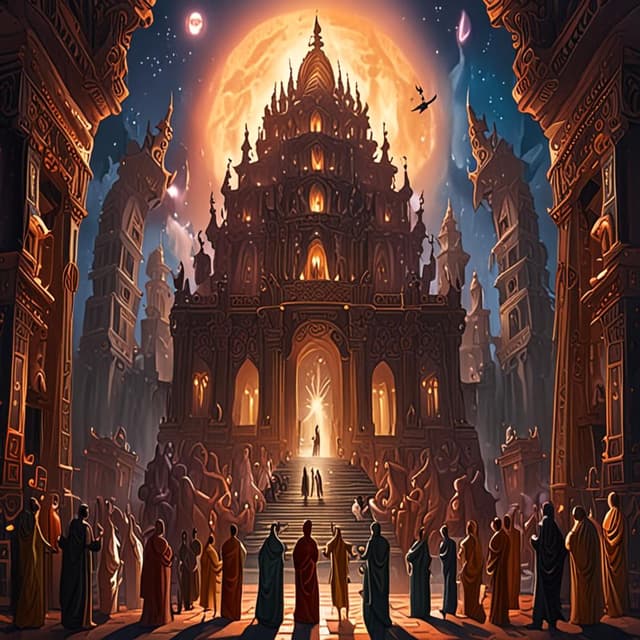
| Premise | An alternate timeline where humanity's understanding of the divine is shaped by the presence of multiple 'Omnipotent' beings - entities with immense but limited powers who interact with and guide the course of human affairs |
| Key Features | Omnipotent beings with a wide range of profound powers • These deities field questions from curious humans but provide ambiguous, contradictory or unsatisfactory answers • The complex and perplexing relationship between the powerful yet fallible deities and the people who revere (and sometimes challenge) them |
| Significance | This alternate cosmology presents a thought-provoking exploration of the human desire for certainty about the divine and the nature of existence, juxtaposed with the limitations and flaws of the godlike figures who shape the course of human civilization |
In the cosmology of this alternate timeline, the universe is not presided over by a single, all-powerful deity, but rather by a pantheon of distinct entities known as the "Omnipotents." These beings possess incredible, god-like abilities that allow them to influence the physical world, the flow of history, and the very fabric of reality itself. Yet they are not infallible or all-knowing - each Omnipotent has its own unique powers, motivations, and limitations.
Humans in this timeline have long grappled with the nature and intentions of these powerful, mysterious figures. The Omnipotents are often the subject of worship, reverence and speculation, with people seeking answers to the most profound questions about the origins of the universe, the meaning of life, and the true nature of existence.
While the precise number and identities of the Omnipotents varies across different cultures and belief systems, there are a few that are widely recognized:
Each of these entities possesses awe-inspiring abilities that place them far beyond the comprehension of mortal minds. Yet they are not all-knowing or all-powerful - they have their own internal conflicts, limitations, and idiosyncrasies that can lead to unpredictable or contradictory behavior.
Humans have long turned to the Omnipotents for guidance, wisdom and insight into the deepest mysteries of existence. Through prayer, meditation, divination and other spiritual practices, people seek to commune with these god-like beings and gain answers to their most burning questions.
The types of questions posed to the Omnipotents are vast and wide-ranging:
Yet the Omnipotents' responses are often enigmatic, paradoxical or unsatisfying to the human desire for clear, definitive answers. Their powers may be immense, but their knowledge is not limitless - and their motivations and thought processes remain fundamentally alien and inscrutable to mortal minds.
As a result, the Omnipotents are not universally revered or trusted. Many people, driven by skepticism, curiosity or a sense of defiance, challenge the authority and credibility of these god-like beings. Philosophical and theological debates rage on over the validity of the Omnipotents' claims, the reliability of their pronouncements, and the extent of their true powers.
Some argue that the Omnipotents are merely powerful tricksters or illusions, not truly divine at all. Others believe the Omnipotents' knowledge and abilities are far more limited than commonly assumed. And a growing number of people in this timeline advocate for a shift away from traditional Omnipotent-centric cosmologies altogether, in favor of more materialistic, scientific or humanistic worldviews.
Yet the Omnipotents remain a central part of most cultures, deeply woven into the fabric of history, art, literature and daily life. Their continued presence and the unanswered questions they inspire ensure that the debate over their true nature will rage on indefinitely.
